From Random Generation to Directable Performance: How Motion Control AI Lowers the Barrier to Character Animation

Generative video has made it remarkably easy to create a moving image. The harder problem begins after the first impressive result: can a creator control the performance well enough to use it in a campaign, a lesson, a story, or a repeatable content series?
A character does not feel alive simply because it moves. Timing, posture, gestures, facial expression, and the relationship between movement and dialogue all shape the audience's perception. This is why AI video is moving from random generation toward directable production. Creators increasingly want to reuse a performance they already understand instead of hoping that a text prompt produces the right motion.
The expensive part of character animation
Traditional character animation can involve motion-capture hardware, rigging, keyframes, cleanup, and rendering. Even template-based workflows require familiarity with timelines, joints, constraints, and export settings. For an independent creator or a small marketing team, the largest cost is often not the software license. It is the time spent learning specialized tools, coordinating several roles, and correcting small animation problems.
Text-to-video lowers the entry barrier, but words are an imprecise way to describe a complete performance. “Wave enthusiastically and take one step forward” leaves the system to guess the speed, amplitude, body weight, eye line, and emotional tone. A practical alternative is to show the desired performance directly and let AI transfer it to a character.
From describing motion to providing motion
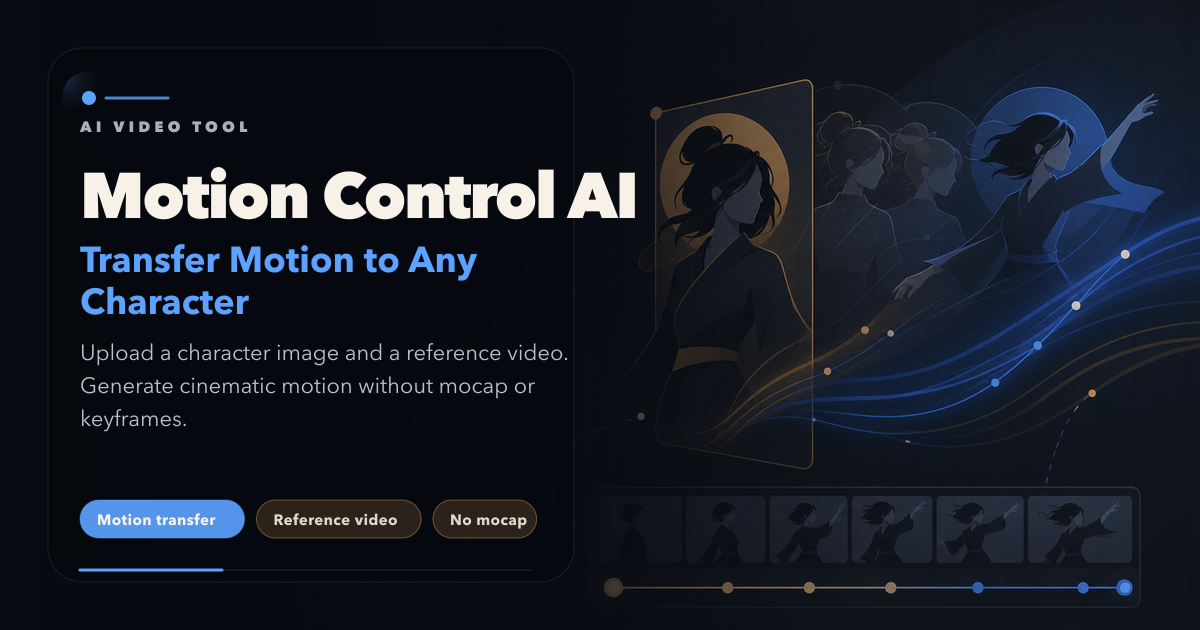
Motion Control AI is built around this idea. A creator provides a character image and a reference video containing the desired movement. The system transfers body motion, gestures, and expressions to the character, reducing the need for manual keyframing or a dedicated motion-capture setup.
This changes the creative relationship with the model. The human remains responsible for acting, timing, and storytelling; AI handles the technical translation between a reference performance and a different visual character. A smartphone recording can become a form of direction that is much more concrete than a long prompt.
A repeatable production workflow
- Define the job of the clip. A reaction shot, an educational explanation, and a mascot dance need different levels of movement. Decide the destination platform, aspect ratio, duration, and call to action before creating assets.
- Choose a readable character image. A clear silhouette, visible limbs, and limited occlusion give the system better structural information. A complicated background rarely improves the performance.
- Record a clean reference. Keep the camera stable, use adequate light, and keep the performer in frame. Start with one short, distinct action before attempting a complex sequence.
- Change one variable at a time. If a result is weak, test the character image, reference motion, and output settings separately. Controlled iteration reveals the actual source of a problem.
- Finish the clip in context. Add captions, voice, music, brand elements, and transitions during editing. Asking one generation to solve every production requirement makes the result less predictable.
Where motion transfer is especially useful
- Virtual characters and VTubers: use a human performance to produce recurring reactions, explanations, and story scenes for a consistent character.
- Brand and commerce content: let a mascot demonstrate an idea, present a product, or participate in a seasonal campaign without building a full 3D pipeline.
- Education: transfer clear teaching gestures to a historical figure, cartoon guide, or course character to make explanations more approachable.
- Independent filmmaking: test blocking and rhythm before committing time and money to final production.
Three principles that improve results
First, the reference video matters more than an elaborate prompt. Clear motion leaves fewer details for the system to invent. Second, character design must support the intended action. A character whose arms are hidden cannot be expected to reproduce complex hand gestures reliably. Third, short clips are easier to direct than long sequences. Several controlled shots can be edited into a stronger scene than one overloaded generation.
AI does not remove the need for direction; it changes how direction is communicated. The durable skill is not memorizing more buttons, but learning to design a performance, prepare useful inputs, and judge whether a result serves the story. Motion transfer compresses a technically heavy animation process into an understandable set of creative decisions, allowing more people to focus on character, rhythm, and meaning.
过去几年,生成式 AI 让“做出一段视频”变得前所未有地容易。但当创作者真正把 AI 视频用于广告、短剧、教育或社交内容时,问题很快从“能不能生成”变成了“能不能控制”。角色什么时候转身、手势是否自然、表情是否与语气一致,这些细节决定了视频究竟只是一次有趣的实验,还是能够进入稳定生产流程的内容资产。
这也是角色动画领域正在发生的变化:行业的重心正从随机生成转向可控导演。创作者不再满足于反复抽卡,而是希望把自己已经验证过的表演、镜头节奏和人物设定准确地组合起来。
角色动画真正昂贵的部分是什么
传统角色动画通常需要动作捕捉设备、骨骼绑定、关键帧制作和后期合成。即使使用现成模板,创作者仍然需要理解时间轴、关节约束和渲染参数。对于独立创作者、小型团队和营销人员来说,最大的成本往往不是购买软件,而是学习复杂工具、协调人员以及不断返工。
纯文本生成视频降低了第一步的门槛,却带来了新的不确定性:同一句提示词可能得到不同动作,角色的一致性难以保持,复杂手势也很难只靠文字描述。更实际的方法,是让人先完成表演,再让 AI 把这段表演迁移到目标角色上。
从“描述动作”到“提供动作”
Motion Control AI 的核心思路,是把一段参考视频中的身体动作、手势和表情迁移到一张角色图片。创作者不必学习动作捕捉或逐帧动画,只需要准备两个输入:一张清晰的角色图,以及一段包含目标动作的参考视频。
这种工作方式把抽象的提示词变成了具体的表演。与其输入“人物兴奋地挥手并向前一步”,不如直接录下想要的节奏、幅度和情绪。AI 负责把动作映射到角色,创作者则继续掌握表演和叙事。
一个可复用的制作工作流
- 先确定输出目的。广告口播、故事片段和虚拟角色舞蹈需要的动作强度不同。先明确平台、画幅和时长,能减少无效尝试。
- 选择轮廓清楚的角色图。完整可见的四肢、较少的遮挡和清晰的主体边缘,更有利于保持动作结构。复杂背景并不会增加角色表现力,反而可能分散模型注意力。
- 录制简洁的参考动作。镜头稳定、光线充足、动作主体完整入镜。第一次测试应使用短而明确的动作,验证角色适配后再增加复杂度。
- 控制变量进行迭代。一次只改变角色图、动作视频或输出设置中的一个因素。这样才能判断问题来自输入素材还是动作本身。
- 把结果纳入后期流程。生成视频适合继续添加字幕、配音、音乐和品牌元素,而不是把所有要求都压在一次生成中。
哪些场景最值得使用动作迁移
- 虚拟角色与 VTuber:用真人表演驱动固定角色,持续生产口播、反应和剧情内容。
- 电商与品牌营销:让吉祥物演示动作、介绍产品或参与节日活动,而无需反复搭建三维动画。
- 教育内容:把讲解手势迁移到历史人物、卡通教师或课程角色,增强知识表达的亲和力。
- 独立影视与分镜:快速验证人物动作和镜头节奏,在投入正式制作之前发现叙事问题。
提高成功率的三个原则
第一,参考视频的价值高于冗长提示词。动作越清晰,系统需要猜测的部分越少。第二,角色造型要服务于动作:如果角色没有清楚的手臂结构,就不应期待复杂手势完全准确。第三,短片段比长镜头更容易控制,可以先分别生成,再通过剪辑形成完整段落。
AI 不会让导演工作消失,它改变的是导演表达意图的方式。未来更有价值的能力,不是记住更多软件按钮,而是知道如何设计表演、选择素材和判断结果。动作迁移把角色动画中最重的技术环节压缩成可理解的输入输出,让更多创作者能够把注意力重新放回人物、节奏与故事本身。
Generative video has made it remarkably easy to create a moving image. The harder problem begins after the first impressive result: can a creator control the performance well enough to use it in a campaign, a lesson, a story, or a repeatable content series?
A character does not feel alive simply because it moves. Timing, posture, gestures, facial expression, and the relationship between movement and dialogue all shape the audience's perception. This is why AI video is moving from random generation toward directable production. Creators increasingly want to reuse a performance they already understand instead of hoping that a text prompt produces the right motion.
The expensive part of character animation
Traditional character animation can involve motion-capture hardware, rigging, keyframes, cleanup, and rendering. Even template-based workflows require familiarity with timelines, joints, constraints, and export settings. For an independent creator or a small marketing team, the largest cost is often not the software license. It is the time spent learning specialized tools, coordinating several roles, and correcting small animation problems.
Text-to-video lowers the entry barrier, but words are an imprecise way to describe a complete performance. “Wave enthusiastically and take one step forward” leaves the system to guess the speed, amplitude, body weight, eye line, and emotional tone. A practical alternative is to show the desired performance directly and let AI transfer it to a character.
From describing motion to providing motion
Motion Control AI is built around this idea. A creator provides a character image and a reference video containing the desired movement. The system transfers body motion, gestures, and expressions to the character, reducing the need for manual keyframing or a dedicated motion-capture setup.
This changes the creative relationship with the model. The human remains responsible for acting, timing, and storytelling; AI handles the technical translation between a reference performance and a different visual character. A smartphone recording can become a form of direction that is much more concrete than a long prompt.
A repeatable production workflow
- Define the job of the clip. A reaction shot, an educational explanation, and a mascot dance need different levels of movement. Decide the destination platform, aspect ratio, duration, and call to action before creating assets.
- Choose a readable character image. A clear silhouette, visible limbs, and limited occlusion give the system better structural information. A complicated background rarely improves the performance.
- Record a clean reference. Keep the camera stable, use adequate light, and keep the performer in frame. Start with one short, distinct action before attempting a complex sequence.
- Change one variable at a time. If a result is weak, test the character image, reference motion, and output settings separately. Controlled iteration reveals the actual source of a problem.
- Finish the clip in context. Add captions, voice, music, brand elements, and transitions during editing. Asking one generation to solve every production requirement makes the result less predictable.
Where motion transfer is especially useful
- Virtual characters and VTubers: use a human performance to produce recurring reactions, explanations, and story scenes for a consistent character.
- Brand and commerce content: let a mascot demonstrate an idea, present a product, or participate in a seasonal campaign without building a full 3D pipeline.
- Education: transfer clear teaching gestures to a historical figure, cartoon guide, or course character to make explanations more approachable.
- Independent filmmaking: test blocking and rhythm before committing time and money to final production.
Three principles that improve results
First, the reference video matters more than an elaborate prompt. Clear motion leaves fewer details for the system to invent. Second, character design must support the intended action. A character whose arms are hidden cannot be expected to reproduce complex hand gestures reliably. Third, short clips are easier to direct than long sequences. Several controlled shots can be edited into a stronger scene than one overloaded generation.
AI does not remove the need for direction; it changes how direction is communicated. The durable skill is not memorizing more buttons, but learning to design a performance, prepare useful inputs, and judge whether a result serves the story. Motion transfer compresses a technically heavy animation process into an understandable set of creative decisions, allowing more people to focus on character, rhythm, and meaning.


评论
发表评论